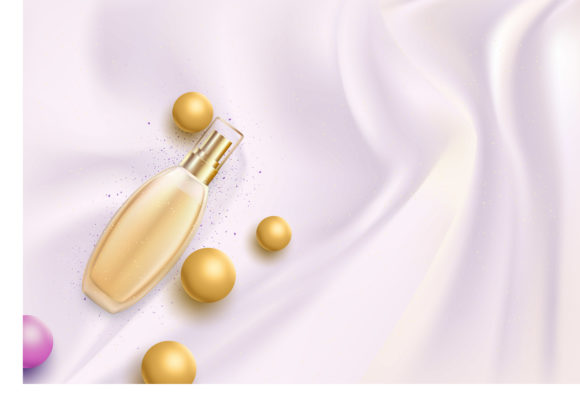
Perfume Mockup with Silk Fabric
If you’ve ever tried to showcase a new fragrance line—whether it’s a small-batch artisan scent, a boutique brand launch, or even a student project—and found yourself staring at flat product photos that just don’t convey luxury, warmth, or texture—you’re not alone. That’s where a perfume mockup with silk fabric steps in—not as a gimmick, but as a practical visual tool that bridges the gap between concept and credibility.
What It Actually Is (and What It’s Not)
A perfume mockup with silk fabric is a high-fidelity digital template designed to place your perfume bottle design onto a realistic, softly draped silk surface. Unlike generic white-background mockups, this version uses real-world material properties: subtle light reflection, gentle folds, soft shadow gradients, and the delicate translucency silk offers when backlit or angled just right. It’s not a photo of an actual bottle on real silk—it’s a smart PSD or PNG-based file (often layered and editable) that lets you swap in your label, cap, and bottle shape while preserving natural lighting, depth, and tactile nuance.
It’s not meant for mass production packaging. It won’t replace physical sampling or lab testing. But it *does* solve a very specific, recurring problem: how to make a fragrance feel intentional, refined, and sensorially rich—before a single drop is bottled.
When You’ll Reach for It (and Why Timing Matters)
You’ll reach for a perfume mockup with silk fabric most often in the “in-between” moments—the stretch between idea and execution, pitch and buy-in, prototype and promotion. Think:
- Weeks before your Etsy listing goes live, and you need lifestyle shots that signal “hand-poured, thoughtfully composed”—not “printed on demand.”
- During a client presentation for a luxury skincare brand expanding into fragrance—where the silk backdrop quietly reinforces premium positioning without saying a word.
- While drafting a grant application for a design school project, and you need to show aesthetic cohesion across scent, typography, and material language.
- When refreshing Instagram Stories for a seasonal scent drop—and you want continuity between your bottle graphic and the soft, flowing visuals your audience associates with self-care rituals.
The timing matters because silk isn’t neutral. It carries connotation—elegance, intimacy, quiet confidence. Using it too early (e.g., in rough wireframes) feels premature; using it too late (e.g., after final packaging is printed) misses the chance to influence tone and direction. It’s most powerful when used *during* visual storytelling—not after.
Real People, Real Uses
A freelance packaging designer in Portland uses a perfume mockup with silk fabric to test how her label’s gold foil treatment reads under warm ambient light—adjusting contrast and spacing before sending files to the printer. She doesn’t need to order physical proofs every time; she gets faster, more confident iterations.
A wellness blogger launching her first signature scent uploads her minimalist bottle sketch into the mockup, then shares the result in a “behind-the-scent” email. Her readers comment not on the notes—but on how “calm” and “grounded” the image feels. The silk isn’t decoration; it’s part of the emotional translation.
A university professor teaching sensory branding assigns students to reinterpret a classic fragrance using only visual tools—no copy, no sound. One group chooses a perfume mockup with silk fabric to explore how texture implies olfactory qualities: soft folds = amber base; luminous sheen = citrus top note. It becomes a tactile entry point into abstract concepts.
A small-batch perfumer in Lisbon uses the same mockup across three platforms: her Shopify homepage (cropped tightly), Pinterest pins (with soft background blur), and press kits (with subtle branded watermark). Consistency builds recognition—even before customers smell anything.
What to Check Before You Download or Buy
Not all perfume mockups with silk fabric deliver the same results. Here’s what actually affects your outcome:
- Lighting direction and realism: Does the silk catch light like real silk—or does it look plasticky or overly uniform? Look for subtle variation in highlight intensity and fold depth.
- Editable layers: Can you adjust the silk’s opacity, color tone, or shadow intensity independently? This lets you match your brand’s mood—e.g., cool-toned silk for a mint-and-ozonic scent, warmer tones for vanilla and sandalwood.
- Resolution and scalability: Will it hold up in print for a boutique brochure (300 DPI) and also load quickly on mobile (optimized file size)? Avoid huge PSDs unless you’re editing in Photoshop regularly.
- Licensing clarity: Does the license cover commercial use—including client work and social ads—or just personal projects? Some creators assume “free download” means “free to sell,” which isn’t always true.
Also consider your workflow. If you primarily use Canva or Figma, check whether the mockup comes in PNG with transparent cutouts—or if it requires layer-based software. A beautiful mockup is useless if you can’t open it.
Why “Silk” Isn’t Just a Trendy Word
Silk works for perfume mockups because it mirrors how people experience scent: indirectly, through association and memory. You don’t “see” jasmine—you recall a humid summer evening, a grandmother’s scarf, the hush of a candlelit room. Silk evokes similar feelings: drape suggests movement and breath; sheen implies subtlety, not flash; texture invites touch, even virtually.
That’s why swapping silk for linen or velvet changes the message entirely. Linen says “effortless, earthy, daytime.” Velvet says “rich, opulent, evening.” Silk sits in the middle—refined but approachable, structured but fluid. It supports the scent rather than competing with it.
When your audience lingers on an image for two seconds longer—because the light catches the silk just so, or the fold echoes the curve of your bottle—they’re not just looking. They’re beginning to imagine wearing it.
One Last Practical Note
A perfume mockup with silk fabric won’t fix weak branding, inconsistent typography, or vague scent descriptions. But it *will* elevate strong work—making thoughtful details visible, helping viewers feel the intention behind your choices, and giving your fragrance a visual voice that aligns with its character. Use it not to mask uncertainty, but to amplify clarity. And if you find yourself reaching for it again and again—not as a shortcut, but as a consistent part of how you translate scent into sight—that’s when you know it’s earned its place in your toolkit.