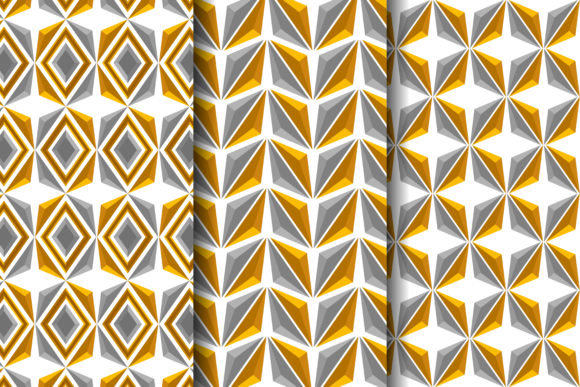
Seamless 3D Pattern
A Seamless 3D Pattern refers to a digitally generated surface texture or geometry that repeats infinitely in two or three dimensions without visible seams, discontinuities, or distortion—while retaining volumetric depth, lighting response, and spatial coherence. Unlike traditional 2D seamless textures (e.g., tiled PNGs), Seamless 3D Patterns encode depth, normal variation, displacement, or even procedural volume data, enabling realistic rendering across curved, irregular, or dynamically deformed surfaces in real time or offline pipelines.
This capability is especially relevant for designers, technical artists, product developers, and engineers working with digital fabrication, architectural visualization, game assets, AR/VR environments, or generative design systems. It bridges the gap between flat texture mapping and fully modeled geometry—offering scalability, editability, and performance efficiency where appropriate.
Why Consider a Seamless 3D Pattern?
Users typically explore Seamless 3D Pattern solutions when facing one or more of these practical challenges:
- Creating large-scale, repeatable surface treatments—such as brickwork on a building facade, organic growth on a terrain mesh, or micro-texturing on industrial components—without manual tiling or excessive polygon counts.
- Need for real-time adaptability: adjusting scale, orientation, or material properties interactively while preserving visual continuity across UV boundaries or mesh seams.
- Integrating parametric control into production workflows—for example, varying pattern density based on curvature or environmental exposure in architectural simulation.
- Reducing memory footprint and draw calls compared to high-resolution baked textures or dense instanced geometry.
These motivations reflect functional needs—not just aesthetic preferences. A Seamless 3D Pattern becomes valuable not because it’s novel, but because it solves specific constraints around scalability, consistency, and maintainability.
Key Benefits and Realistic Tradeoffs
The primary benefit lies in spatial coherence at scale. Because the pattern encodes volumetric relationships—not just color or height—it responds naturally to lighting, shadow, and perspective shifts. This improves realism in close-up inspection and maintains fidelity across wide-angle views. It also supports non-planar projection: patterns can wrap consistently around cylinders, spheres, or organic forms without manual UV unwrapping or seam masking.
However, several tradeoffs require careful evaluation:
- Tooling and pipeline compatibility: Not all rendering engines or modeling applications support true 3D procedural patterns natively. Some require custom shaders, GPU-accelerated noise functions, or integration with node-based tools like Substance Designer, Houdini, or Blender’s Geometry Nodes.
- Performance cost vs. static alternatives: While often more memory-efficient than ultra-high-res textures, complex Seamless 3D Patterns may increase shader computation per pixel—especially when combining multiple layered noise functions, triplanar blending, or runtime tessellation.
- Editability versus predictability: Procedural generation offers flexibility but can make precise artistic control harder. Matching a specific reference image or aligning with brand guidelines may demand additional iteration or hybrid approaches (e.g., baking key frames or using guided noise).
- Export limitations: Most Seamless 3D Patterns remain tied to their authoring environment. Exporting to widely supported formats like glTF or FBX usually flattens them into standard maps (albedo, normal, roughness), losing their procedural nature and adaptive behavior.
Situations Where Seamless 3D Pattern Is a Strong Fit
A Seamless 3D Pattern is particularly well-suited when:
- You’re developing assets for interactive applications—games, configurators, or virtual showrooms—where users manipulate objects in real time and expect consistent surface behavior under rotation, zoom, or deformation.
- Your project involves generative or algorithmic design, such as parametric architecture or procedural world-building, and you need patterns that respond meaningfully to input parameters (e.g., “increase fractal complexity where slope exceeds 30°”).
- You’re iterating rapidly on material concepts and want to avoid re-baking textures for every minor adjustment—especially during early-stage exploration or client review cycles.
- Your target platform supports modern shading models (e.g., Vulkan, Metal, WebGL 2.0+) and your team has access to shader development resources or pre-built node libraries.
In these contexts, the ability to decouple pattern logic from resolution or topology delivers tangible workflow advantages—not just visual ones.
When Alternatives May Be More Practical
Conversely, consider alternatives if:
- Your delivery format is constrained to legacy platforms—such as older web viewers, embedded systems, or certain CAD viewers—that only accept standard texture maps and lack shader extensibility.
- Project timelines prioritize speed over flexibility: a carefully crafted 4K seamless 2D texture may be faster to implement, test, and approve than building and debugging a custom Seamless 3D Pattern system.
- The intended use is static: printed materials, fixed-angle renders, or archival documentation where runtime adaptation provides no functional benefit.
- Team expertise leans toward traditional texturing or modeling rather than procedural techniques—introducing a Seamless 3D Pattern could slow down adoption or increase maintenance overhead without proportional return.
Also note that “seamless” does not automatically imply “high-fidelity.” A poorly authored Seamless 3D Pattern can produce banding, aliasing, or unnatural repetition—just as a low-quality 2D tile can. Quality depends on implementation rigor, not dimensionality alone.
Making an Informed Decision
To determine whether a Seamless 3D Pattern aligns with your goals, ask these questions:
- What problem are you solving? If the issue is visual repetition at edges, a 2D seamless texture may suffice. If it’s inconsistent depth perception across bent surfaces or dynamic scaling, then 3D coherence matters more.
- Where will this asset be used—and for how long? Long-lived digital products with evolving requirements benefit more from procedural foundations than short-term marketing visuals.
- Who maintains it after launch? Evaluate whether your team can update, debug, or document the pattern logic over time—or whether it will become a black box requiring specialist intervention.
- What’s your tolerance for compromise? Can you accept slight variations in appearance across different hardware, or do you need pixel-perfect consistency across all target devices?
No single solution fits every use case. Seamless 3D Pattern is a tool—not a default. Its value emerges most clearly when matched to specific technical constraints and creative objectives—not adopted as a trend or assumed upgrade over conventional methods.
Before committing, prototype at minimal scope: generate a small section of your intended surface using both a Seamless 3D Pattern and a high-quality 2D alternative. Compare results under your actual lighting conditions, viewing angles, and target resolutions. Measure not just visual fidelity, but also integration time, file size, render performance, and ease of future modification. That comparison—not theoretical advantage—will guide the most reliable decision.