What Is a 3D Globe on a Book? Exploring Its Meaning, Uses, and Creative Impact
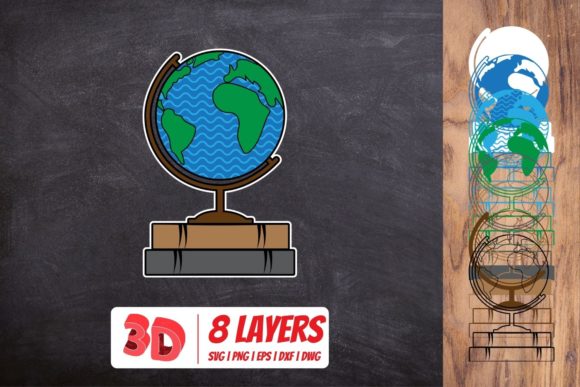
A 3D globe on a book is more than just an eye-catching design—it’s a thoughtful fusion of geography, tactile learning, and visual storytelling. At its core, it refers to a physical or illustrated representation of Earth rendered in three dimensions—complete with curvature, elevation, and often interactive or embossed features—integrated directly onto the cover, spine, or interior pages of a book. This concept appears across educational textbooks, art books, children’s atlases, coffee-table publications, and even limited-edition literary releases.
Why Does a 3D Globe Belong on a Book?
The inclusion of a 3D globe isn’t merely decorative. It serves several meaningful functions:
- Enhanced spatial understanding: Unlike flat maps, a 3D globe preserves true proportions, distances, and continental relationships—helping readers grasp concepts like time zones, axial tilt, and hemispheric balance without distortion.
- Tactile engagement: Embossed or raised-globe covers invite touch, supporting multisensory learning—especially valuable for young readers, visually impaired learners, and kinesthetic students.
- Symbolic resonance: A globe on a book signals global awareness, curiosity, and interconnectedness—reinforcing themes of exploration, sustainability, cultural diversity, or scientific literacy.
- Design distinction: In a crowded publishing market, a dimensional globe makes a title stand out on shelves and online thumbnails, improving discoverability and perceived value.
How It Works: From Concept to Printed Reality
Creating a 3D globe on a book involves collaboration between cartographers, designers, printers, and sometimes educators. Here’s how it typically unfolds:
- Geographic accuracy first: Designers start with up-to-date geospatial data—often sourced from NASA, NOAA, or open-access GIS platforms—to ensure coastlines, political boundaries, and topography reflect current reality.
- Dimensional translation: Using specialized software (like Blender or Adobe Dimension), artists convert spherical coordinates into scalable 3D models optimized for print—balancing realism with legibility at small sizes.
- Production techniques: Depending on budget and purpose, the globe may be achieved through:
- Embossing or debossing: Pressing paper or cardboard to create subtle, tactile relief;
- Spot UV coating: Adding glossy, raised texture over printed globe elements;
- Die-cut layered covers: Stacking transparent or semi-opaque layers to simulate depth;
- Digital augmentation: Pairing a printed globe with AR apps that animate rotation, labels, or climate data when scanned with a smartphone.
- Educational integration: In classroom editions, the 3D globe often links to QR-coded activities, augmented reality pop-ups, or companion workbooks that turn passive viewing into active inquiry.
Education: Building Geoliteracy from Page One
In elementary and middle-school social studies, a 3D globe on a textbook cover immediately signals “this is about our world”—not abstract lines on a page. For example, Our Changing Earth: A Junior Atlas uses a rotating, textured globe on its cover that mirrors the interior’s fold-out, tear-resistant globe map. Teachers report improved student recall of equatorial climates and ocean currents when lessons begin with hands-on reference to that same 3D form.
Environmental Communication: Visualizing Global Systems
Books like Ice, Fire, and Air: Climate Stories from Six Continents feature a thermally reactive 3D globe on the cover—shifting color subtly with temperature changes. This isn’t gimmickry; it mirrors the book’s central thesis: Earth’s systems are dynamic, responsive, and interdependent. Readers intuitively connect the tactile experience with the narrative’s urgency.
Creative Publishing: Where Art Meets Geography
Artists and publishers increasingly treat the 3D globe as a canvas. In Cartographies of Memory, a limited-run memoir, each copy includes a hand-embossed globe where key life locations (birthplace, migration routes, ancestral homelands) are subtly raised—transforming geography into personal narrative. Here, the globe isn’t just illustrative—it’s autobiographical infrastructure.
Common Misconceptions—Clarified
Despite growing popularity, several assumptions persist around 3D globes on books. Let’s clear them up:
- “It’s only for kids.” While highly effective in early education, dimensional globes appear in university-level geophysics texts, UN policy reports, and architectural theory volumes—where spatial reasoning remains essential.
- “A 3D globe replaces the need for a physical globe.” Not quite. A book-based globe offers portability and contextual anchoring—but can’t replicate full rotational manipulation or scale comparison. They’re complementary tools, not substitutes.
- “All 3D globes are equally accurate.” Accuracy varies widely. Some prioritize aesthetics over fidelity—distorting polar regions or omitting bathymetric detail. Always check sourcing notes or cartographic credits when selecting for learning or research.
- “It’s just a trend.” While design trends come and go, the pedagogical and cognitive benefits of 3D spatial representation are backed by decades of research in cognitive psychology and STEM education—making this far more than a passing fad.
Beyond the Cover: How This Idea Fits Into Modern Life
In an age of digital saturation, the 3D globe on a book represents a quiet counterbalance: slower, tangible, intentional. Consider how it shows up beyond classrooms:
- In remote learning kits, where families receive tactile geography tools—including books with raised-globe covers—to reduce screen fatigue and reinforce offline exploration.
- In corporate sustainability reports, where forward-thinking companies use embossed globes to visualize carbon footprint distribution, supply chain origins, or reforestation progress—making complex data feel human-scale and grounded.
- In public libraries’ “Explore the World” displays, where books with 3D globes sit alongside globes, compasses, and travel journals—inviting browsing, conversation, and unplanned discovery.
- In neurodiverse learning spaces, where sensory-friendly editions with textured globes support focus, memory encoding, and emotional connection to global topics.
Choosing or Creating a Meaningful 3D Globe Book
If you’re selecting one for learning, gifting, or inspiration, consider these practical tips:
- Look for context: Does the globe tie meaningfully to the book’s content—or is it purely ornamental? The strongest examples integrate form and function.
- Check production quality: Raised elements should be durable, evenly applied, and safe for handling (no sharp edges or peeling coatings).
- Verify data currency: Especially for titles covering climate, borders, or demographics, publication date and data sources matter.
- Consider accessibility: Does the edition include alt-text descriptions, braille labels, or companion audio guides? Inclusive design expands impact.
For creators and publishers, remember: a 3D globe shouldn’t be added last-minute as decoration. It works best when conceived alongside editorial planning—shaping chapter structure, illustration style, and even typography to honor the globe’s centrality.
A Final Thought: More Than a Shape—A Mindset
A 3D globe on a book quietly challenges us to think beyond flat binaries—north/south, us/them, local/global. It reminds us that perspective matters, that scale shifts meaning, and that understanding our place in the world begins not with memorization, but with orientation—literal and metaphorical. Whether you’re a student tracing trade winds, a policymaker assessing drought patterns, or a parent sharing stories of distant lands, that raised curve on the cover invites you to pause, rotate your view, and see anew.
So next time you spot a book with a 3D globe, don’t just admire its craftsmanship—consider what it asks you to hold: not just knowledge, but responsibility, wonder, and connection. And if you’re curious to explore further, check out resources from the National Geographic Education team or the CartoTalk community—both offer free toolkits for bringing dimensional geography into everyday learning.