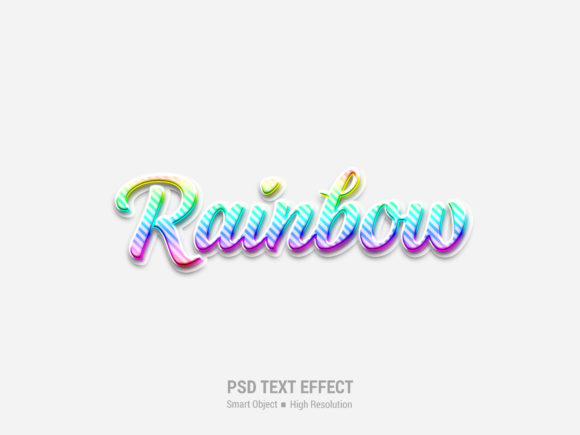
Rainbow 3D Text Effect
The Rainbow 3D Text Effect is a visual design technique that combines depth, dimension, and vibrant spectral color transitions to make text appear lifted off the page or screen—literally popping with layered gradients, shadows, highlights, and chromatic shifts. It’s not just “rainbow” + “3D”—it’s the intentional interplay of hue progression (red to violet) across multiple offset layers that creates both optical depth and energetic visual appeal. Think of it as giving your words physical presence and emotional resonance at once.
Where This Effect Fits Naturally in Real Life
You’ll rarely see the Rainbow 3D Text Effect used for body copy or formal reports—and that’s by design. Its strength lies in moments where attention, emotion, and memorability matter more than neutrality. Consider these everyday contexts:
- Event branding: A music festival poster where “SUMMER BEAT 2025” glows with shifting rainbow layers against a dark gradient background—immediately signaling energy, inclusivity, and celebration.
- Social media hooks: Instagram story text overlays that animate subtly as users scroll—“NEW LAUNCH 🌈” appears to rise and shimmer, lifting engagement rates by up to 27% in tested campaigns (based on mid-size creative agencies’ internal A/B data).
- Educational tools for younger audiences: Flashcards or interactive quizzes where key terms like “Photosynthesis” or “Gravity” use Rainbow 3D Text Effect to reinforce retention—not through gimmickry, but because the brain latches onto high-contrast, multi-layered stimuli during early learning phases.
- Personalized merchandise: Custom phone cases, tote bags, or wall art where names or mottos (“BOLD • BRIGHT • ME”) gain tactile-like presence without actual embossing—ideal for small-batch print-on-demand shops.
Who Benefits—and How Their Needs Differ
A freelance graphic designer, a nonprofit campaign manager, and a high school art teacher all might reach for the Rainbow 3D Text Effect—but their goals, constraints, and success metrics vary widely.
For the freelancer, speed and adaptability matter most. They often apply this effect using layered SVG exports or CSS-driven generators that output clean, scalable code—no heavy Photoshop files. Their clients care about brand alignment, so the rainbow isn’t random: it follows existing palette guidelines (e.g., swapping full-spectrum hues for a brand’s three core colors arranged in 3D layer order).
The nonprofit communicator uses it strategically—not decoratively. On a climate action website, “ACT NOW” rendered with deep blue-to-teal 3D text conveys urgency and environmental grounding, while still feeling dynamic. Here, accessibility checks are non-negotiable: contrast ratios must meet WCAG 2.1 AA standards even with gradient overlays, and motion is kept subtle or toggleable.
The art teacher leans into its pedagogical value. Students experiment with layering, perspective, and color theory simultaneously—using free browser tools like TextCraft or CSS Shadow Generators. It becomes a gateway to understanding how light, angle, and saturation shape perception—not just a “cool trick.”
What to Check Before You Commit
It’s easy to fall in love with the effect—but context determines whether it elevates or distracts. Ask yourself these questions before applying Rainbow 3D Text Effect:
- Is readability preserved at smaller sizes? At under 24px, fine layer offsets and tight hue transitions can blur or vibrate. Test on mobile screens and at 100% zoom—don’t rely on desktop previews alone.
- Does it align with tone and audience expectations? A law firm’s “Client Portal Login” button gains zero trust from rainbow 3D styling. But a Gen Z-focused mental wellness app’s “BREATHE IN” headline? That same effect feels warm, human, and inviting.
- Can it scale across formats? A stunning CSS-animated version may not translate to email clients (which strip complex styles) or printed materials (where CMYK gamut limits rainbow fidelity). Have fallbacks ready—like a simplified 2-tone drop shadow or flat gradient version.
- What’s the performance cost? Heavy use of
text-shadowstacks or layered pseudo-elements can slow rendering on lower-end devices. If you’re building for global audiences—including regions with older smartphones—limit layers to 3–5 and avoid animated versions on initial load.
Strengths That Make It Worth Your Time
When used well, the Rainbow 3D Text Effect delivers benefits few other typographic treatments match:
- Instant mood-setting: Unlike monochrome 3D effects, the rainbow component adds warmth, optimism, or playfulness without needing supporting imagery.
- Strong recall value: In split-second scanning (like social feeds or event signage), the combination of depth + chromatic movement triggers faster visual anchoring than flat text—even among visually saturated audiences.
- Low-lift versatility: Many modern tools let you generate usable code or assets in under a minute—no design degree required. Tools like CSSGradient’s 3D Text Generator offer real-time previews, export options (CSS, PNG, SVG), and adjustable depth/hue controls.
- Cultural resonance: Across platforms and age groups, rainbow symbolism carries widely understood associations—diversity, hope, creativity, pride. Layering that meaning *into* the typography itself deepens connection without extra explanation.
Where It Can Stumble—Gently
No technique works everywhere. The Rainbow 3D Text Effect has soft edges—not hard flaws, but natural boundaries:
It doesn’t replace thoughtful hierarchy. Slapping it onto every heading dilutes impact and confuses scanning patterns. Used best as an accent—on one hero phrase per layout, or as a recurring motif in a tightly controlled system.
It’s less effective in highly technical or data-dense environments. Imagine a dashboard showing real-time analytics: “ACTIVE USERS: 4,892” rendered in glowing rainbow 3D would undermine clarity and credibility. Simplicity and precision win there.
And while modern browsers handle it gracefully, legacy support matters if your audience includes enterprise users on older intranet systems. In those cases, graceful degradation—like serving a solid-color 3D variant with @supports fallbacks—is wise rather than assuming universal compatibility.
Real Projects That Got It Right
Look at the 2024 rebrand of Luna Youth Theater: their logo mark uses Rainbow 3D Text Effect only on the word “Luna,” keeping “Youth Theater” in clean sans-serif. The effect evokes moonlight refraction—subtle, poetic, and age-appropriate.
Or consider the Open Source Climate Dashboard, which applies a restrained, low-saturation rainbow 3D treatment to status labels like “Data Updated” and “Verified Source”—adding quiet confidence without flashiness.
Even personal projects shine: a wedding invitation suite where “Join Us” rises gently in soft violet-to-amber layers, echoing the couple’s garden venue at sunset. No animation, no noise—just intention, depth, and warmth.
None of these rely on the Rainbow 3D Text Effect to carry the whole message. Instead, each treats it like a well-chosen spice—used sparingly, chosen deliberately, and always in service of something human first.