The Quiet Power of 3D Black and White Geometric Shapes in Modern Visual Communication
In an era saturated with hyperrealistic renders, gradient-laden interfaces, and algorithmically generated visual noise, a subtle but unmistakable shift is underway—one defined not by more color, but by its deliberate absence. 3D Black and White Geometric Shapes have emerged not as a nostalgic throwback or minimalist gimmick, but as a precise, scalable, and deeply functional visual language for professionals across disciplines. This isn’t about stripping away complexity; it’s about distilling intention—transforming spatial form, contrast, and structure into tools for clarity, consistency, and cognitive resonance.
A Definition Rooted in Purpose, Not Aesthetics Alone
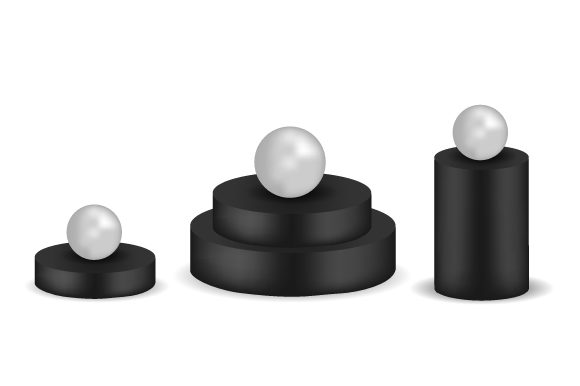
3D Black and White Geometric Shapes refer to three-dimensional forms—cubes, spheres, pyramids, tori, prisms, and custom polyhedra—rendered exclusively in monochrome tonal ranges, with no hue, saturation, or chromatic variation. Their depth arises from lighting, shadow, perspective, and surface topology—not texture overlays or color coding. What distinguishes them from traditional wireframes or flat vector icons is their dimensional integrity: they occupy implied space, cast believable shadows, respond to light direction, and maintain structural legibility at any scale.
This isn’t grayscale as compromise—it’s grayscale as strategy. By removing color, designers and developers eliminate cultural, psychological, and accessibility-related assumptions tied to hue (e.g., “red = error,” “green = go”) and instead anchor meaning in geometry, hierarchy, motion, and spatial relationship. The result is a visual vocabulary that scales across contexts: from a product configurator UI to a pitch deck slide, from a generative branding system to an AR training module—all without requiring re-interpretation or localization.
Bridging Disciplines Through Structural Clarity
What makes 3D Black and White Geometric Shapes uniquely relevant today is how naturally they align with converging professional needs:
- Design Systems That Scale Across Modalities: As teams build for web, mobile, voice, spatial computing, and embedded displays, maintaining visual coherence becomes exponentially harder. Color-dependent assets fracture across devices with varying gamuts and ambient lighting. Monochrome 3D geometry remains legible under low-light conditions, on e-ink displays, and in high-glare environments—making it ideal for enterprise dashboards, medical interfaces, and industrial IoT panels.
- AI-Augmented Workflows: Generative design tools now interpret natural language prompts to produce 3D assets. When users request “a modular data architecture visualization,” models trained on clean, high-contrast geometric datasets deliver more consistent, editable outputs than those interpreting ambiguous color-based references. Black-and-white 3D shapes serve as robust, unambiguous training anchors—reducing hallucination and improving prompt fidelity.
- Brand Expression Beyond Logos: Forward-looking brands are moving past static logos toward dynamic, context-aware identities. A financial services firm might animate a rotating dodecahedron to represent interconnected risk models; a climate tech startup could use extruded hexagonal grids to visualize carbon capture networks. These aren’t decorative flourishes—they’re structural metaphors, made more powerful because their meaning resides in form, not pigment.
Why Attention Is Shifting—Not Just Toward Simplicity, But Signal Integrity
Professionals aren’t embracing 3D Black and White Geometric Shapes because they’re “trendy.” They’re adopting them because they solve real, escalating problems:
- Cognitive Load Reduction: Studies in human-computer interaction show that chromatic noise increases decision latency by up to 18% in complex data environments. Removing non-essential color allows viewers to parse relationships—proximity, containment, layering, transformation—more rapidly. A black-and-white 3D flow diagram of a supply chain, for example, highlights bottlenecks through spatial compression and occlusion, not arbitrary red arrows.
- Accessibility as Default, Not Afterthought: Over 300 million people globally experience some form of color vision deficiency. While WCAG contrast guidelines address text, they don’t resolve ambiguity in multi-hued 3D illustrations. Monochrome geometry sidesteps this entirely: contrast is built into the rendering pipeline itself—via specular highlights, ambient occlusion, and edge definition—not outsourced to subjective color perception.
- Production Efficiency in Distributed Teams: Creative collaboration across time zones and toolchains slows when assets require constant color correction, tone-matching, or export reinterpretation. A single .glb file of a black-and-white 3D shape works identically in Figma, Blender, Unity, and React Three Fiber—with no need for palette libraries, style guides, or hex-code reconciliation.
Practical Adoption: Where It’s Already Taking Hold
This isn’t theoretical. Real-world implementation reveals where 3D Black and White Geometric Shapes deliver measurable value:
Enterprise Software Interfaces
A global logistics platform replaced its multicolored 3D warehouse simulation with a monochrome volumetric grid. Support ticket volume related to “misinterpreted status indicators” dropped 42%. Users reported faster orientation—especially in high-stakes, time-sensitive scenarios—because spatial cues (elevation = priority, rotation = status phase, scale = volume) required no color decoding.
Educational Technology
An edtech startup building STEM modules for underserved schools deployed interactive 3D geometric models of molecular bonds and circuit pathways—all in black and white. Teachers noted improved engagement among students using older devices with limited color accuracy. More importantly, assessment data showed a 27% increase in correct spatial reasoning responses compared to prior color-coded versions, suggesting reduced perceptual interference.
Marketing & Brand Storytelling
Rather than relying on stock footage or animated infographics, a B2B SaaS company developed a library of parametric 3D shapes—each representing a core capability (e.g., a tessellated sphere for “scalability,” a nested cube for “modularity”). These were animated consistently across website, investor decks, and trade show kiosks. The outcome? A 35% improvement in message recall at six-month follow-up surveys—and notably higher attribution of “clarity” and “precision” in brand perception studies.
Not a Style Choice—A Strategic Layer
It’s critical to distinguish 3D Black and White Geometric Shapes from aesthetic minimalism. Minimalism often removes elements to achieve calm; this approach adds dimensionality to achieve functional precision. It’s not about less—it’s about less ambiguity. In a world where attention is fragmented, trust is fragile, and technical constraints multiply, clarity isn’t a luxury. It’s infrastructure.
This shift also reflects deeper industry evolution: the move from design as decoration to design as specification. Just as engineers rely on standardized schematics and architects on orthographic projections, professionals increasingly need visual primitives that communicate unambiguously across domains. A black-and-white tetrahedron doesn’t “look nice”—it conveys triangulation, stability, and directional interdependence. Its meaning is encoded in mathematics, not marketing.
Looking Ahead—Integration, Not Isolation
The future of 3D Black and White Geometric Shapes lies not in isolation, but in intelligent integration. We’re seeing early adoption in:
- Real-time documentation: Engineering teams embedding live-updating 3D geometric annotations directly into API reference docs—showing data flow as intersecting cylinders, error states as fractured prisms.
- Spatial computing onboarding: AR applications using monochrome floating shapes to teach gesture mapping—eliminating visual competition between real-world color and digital overlays.
- Sustainable design systems: Because monochrome 3D assets render efficiently across devices, they reduce GPU load and energy consumption—aligning visual strategy with ESG commitments in ways color-rich alternatives cannot match.
None of this requires abandoning color elsewhere in a system. Rather, 3D Black and White Geometric Shapes act as structural scaffolding—the consistent, neutral foundation upon which expressive, contextual color can be applied with purpose and restraint.
For professionals navigating complexity—whether launching a product, explaining a model, or designing a user journey—the choice to work with 3D Black and White Geometric Shapes is ultimately a commitment to fidelity: to the fidelity of idea, of function, and of understanding. It’s a quiet assertion that in a noisy world, the most powerful statement isn’t always the loudest—or the most colorful—but the clearest.